
Carter County Arrest Records and Court Charges
An arrest record is the law enforcement account of a single arrest. It names who was arrested, who made the arrest, the date, and the booking that came next. In Carter County, most arrests run through the Sheriff's Office or a city police department, and the person is booked into the county jail. The arrest record sits on the law enforcement side. It is not a finding of guilt. A court charge record begins later, when the District Attorney decides what crimes to allege and files them with the Court Clerk.
The two records answer different questions. An arrest record and the booking detail show the custody side, such as the booking date and the offenses listed at intake. That information lives on the jail roster, so the Carter County inmate records page is the place to track custody and release. The court charge record shows the charges after arrest that the prosecutor actually filed and how a judge handles them. The full case file, the pleas, and the outcome run through the Carter County criminal court records. Charges can differ from the arrest. A jail intake may list one offense while the filed charges read another.
- Arrest record
- The law enforcement log of a single arrest and the booking that followed.
- Charge record
- The crimes a prosecutor formally files with the court after an arrest.
- Charging document
- The paper that states the charges and opens the criminal case.
- District Attorney
- The elected prosecutor who decides which charges to file.
How to Find Carter County Arrest Records
Charges and charge status show up in the court case search, not on a single arrest log. Carter County District Court cases run on two free state portals, and the Carter County Court Clerk links both. Use the Oklahoma State Courts Network docket search or the On Demand Court Records portal to pull a Carter County case by name or number. Booking detail, by contrast, sits on the jail roster, so the custody side is tracked through the inmate search rather than the docket.
- Open the OSCN or ODCR case search and choose Carter County District Court.
- Search by the defendant's last and first name, or by a case number such as CF-2026-1.
- Open the case and read the charge list at the top of the docket.
- Check each charge for its statute code, severity level, and current status.
Some records never appear online. Older files, sealed cases, and law enforcement incident reports route elsewhere. For an arrest or incident report, the Sheriff's Office runs a records request process. The fee is five dollars per report, the form is requested by phone, and some reports must be picked up in person. A statewide criminal history is a separate request through the state, covered further down.
How Carter County Charges Get Filed
A Carter County charge record does not begin at the arrest. It begins when the prosecutor files a charging document with the Carter County Court Clerk. That paper states the alleged crimes and opens the case. Oklahoma uses three main charging documents, and the one used depends on the offense and how the case reaches the court.
| Complaint | Information | Indictment | |
|---|---|---|---|
| Filed By | Officer / Prosecutor | Prosecutor | Grand Jury |
| Common For | Misdemeanors | Many felonies | Serious felonies |
| Starts | The case | The case | The case |
A complaint is a sworn allegation that a crime took place. An information is the prosecutor's own formal charging document, and most Carter County felony and misdemeanor cases are filed this way in Carter County District Court. An indictment comes from a grand jury and tends to appear on the most serious felonies. The OSCN and ODCR case-type lists name criminal felony and misdemeanor cases filed by information, which is why the docket often shows the District Attorney as the party that filed the charge.
Carter County Charge Codes and Levels
Every filed charge ties to a statute and carries a severity level. The Carter County case number itself starts with a code that signals the type of case. One arrest can produce several separate charges, and each charge gets its own line on the Carter County docket. Reading the codes makes a case easier to follow.
- CF marks a criminal felony case.
- CM marks a criminal misdemeanor case.
- TR marks a traffic case.
- SW marks a search warrant matter.
- YO marks a youthful offender case.
- CJ and CV mark civil case types that may run alongside a criminal matter.
Severity drives the level. A felony is the more serious class and can carry prison time. A misdemeanor is the lesser class and is handled with lighter penalties. The case number usually joins the code, the filing year, and a sequence number, so a Carter County label like CM-2026-1 reads as a misdemeanor filed in 2026. Each charge in a case keeps its own code and status, even when several charges share one case number.
Reading Carter County Charge Status
Charges rarely stay frozen. As a Carter County case moves, a charge can be amended, reduced, added, dropped, or dismissed. The status on the docket shows where each count stands at that moment. The terms below appear often in Carter County criminal dockets, and each one means something different for the person charged.
| Status | What It Means |
|---|---|
| Pending | The charge is filed and active. No plea or verdict has resolved it yet. |
| Amended / Reduced | The prosecutor changed the charge, often to a lesser offense or a different statute. |
| Dismissed | The court dropped the charge. A dismissal can be with or without the right to refile. |
| Nolle Prosequi | The prosecutor formally chose not to pursue the charge. |
Note: A dropped or dismissed charge can still show on the case index because the filing happened, even though the count no longer moves the case forward.
Who Files Carter County Charges
In Carter County, the District Attorney files charges, not the arresting officer. Melissa Handke serves as District Attorney for Oklahoma's 20th Judicial District, which covers Carter, Love, Murray, Marshall, and Johnston Counties. She is the first female District Attorney for the district. The Carter County office sits at Annex #1, 107 1st Ave SW, Ardmore, OK 73401, with a main line of (580) 223-9674 and a fax of (580) 221-5504. The office also runs a Victim Witness line at (580) 221-5536 and a Bogus Check Division led by Rhonda Cesa at (580) 226-2721.
The prosecutor reviews the arrest, the reports, and the evidence before deciding what to file in Carter County District Court. That review explains why filed charges can differ from the offense listed at booking. The Carter County District Attorney page and the District 20 page list the office contacts and payment links for bogus check, restitution, and supervision balances. People accused who cannot afford a lawyer may have appointed counsel, and OSCN docket entries show public defender and appointed roles in many criminal cases.
Charges vs. Convictions
A charge is an accusation. A conviction is a result. Being charged means the state believes there is enough cause to file, but it does not prove the case. A conviction comes only after a plea or a verdict. This gap matters when reading any Carter County arrest or charge record, because a filed charge can later be reduced, dismissed, or dropped without any finding of guilt.
| Charge | Conviction | |
|---|---|---|
| Stage | Accusation | Verdict or plea |
| Burden of Proof | Probable cause | Beyond reasonable doubt |
| Public Record | Yes | Yes |
Statewide and Federal Charge Lookups
Charges in a single Carter County case do not show a full criminal history. A statewide record pulls charges and dispositions from courts across Oklahoma. The Oklahoma State Bureau of Investigation keeps the state criminal history and runs name-based and fingerprint-based searches. OSBI also handles expungement guidance, and it says it cannot decide eligibility before a court order under 22 O.S. 18. For a broad background look, the statewide history is the better source than one county docket.
Federal charges follow a separate track and never appear in the Oklahoma state portals. Federal cases tied to Carter County residents run through the U.S. District Court for the Eastern District of Oklahoma. The PACER lookup for the Oklahoma Eastern District points to the court's electronic docket and a help desk line.
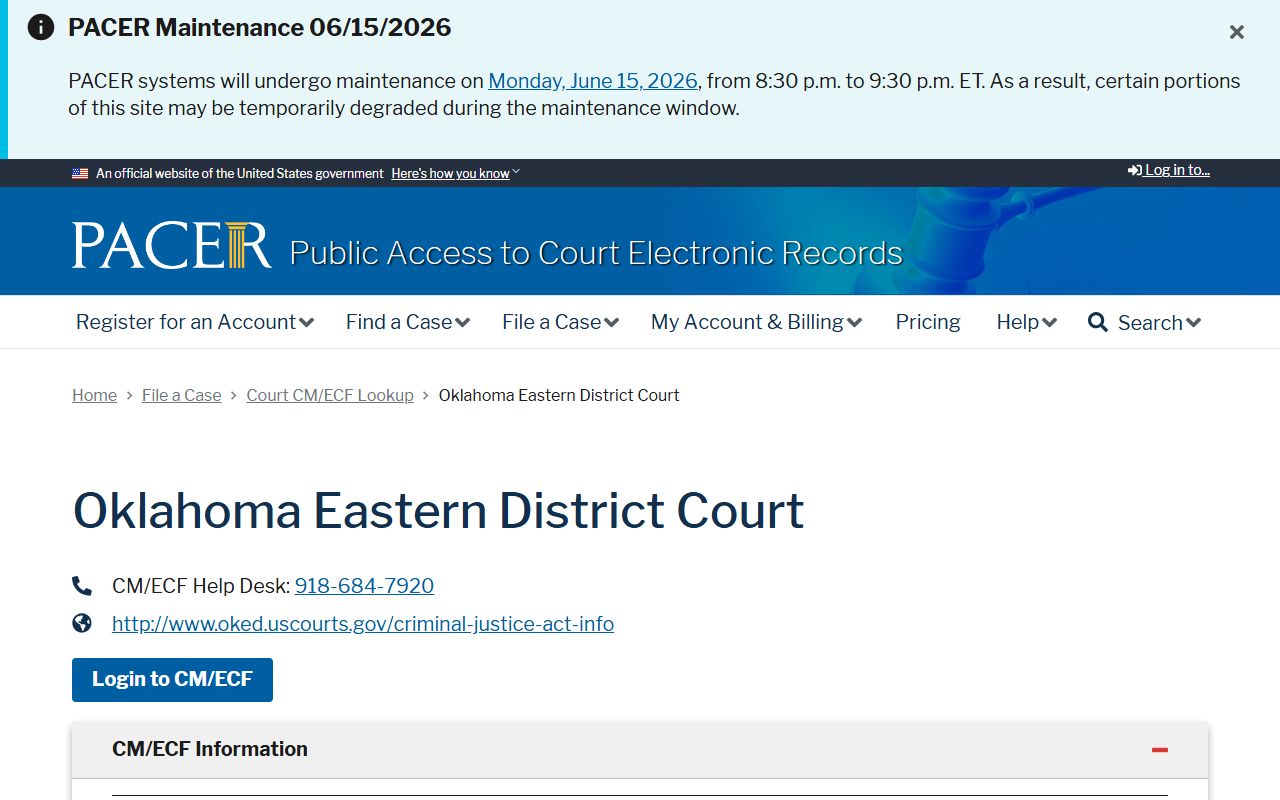
The lookup connects to the case management system where filed federal charges and case status appear. Cases in other districts start from the broader directory instead. The PACER court lookup lists every federal court and its electronic filing system.
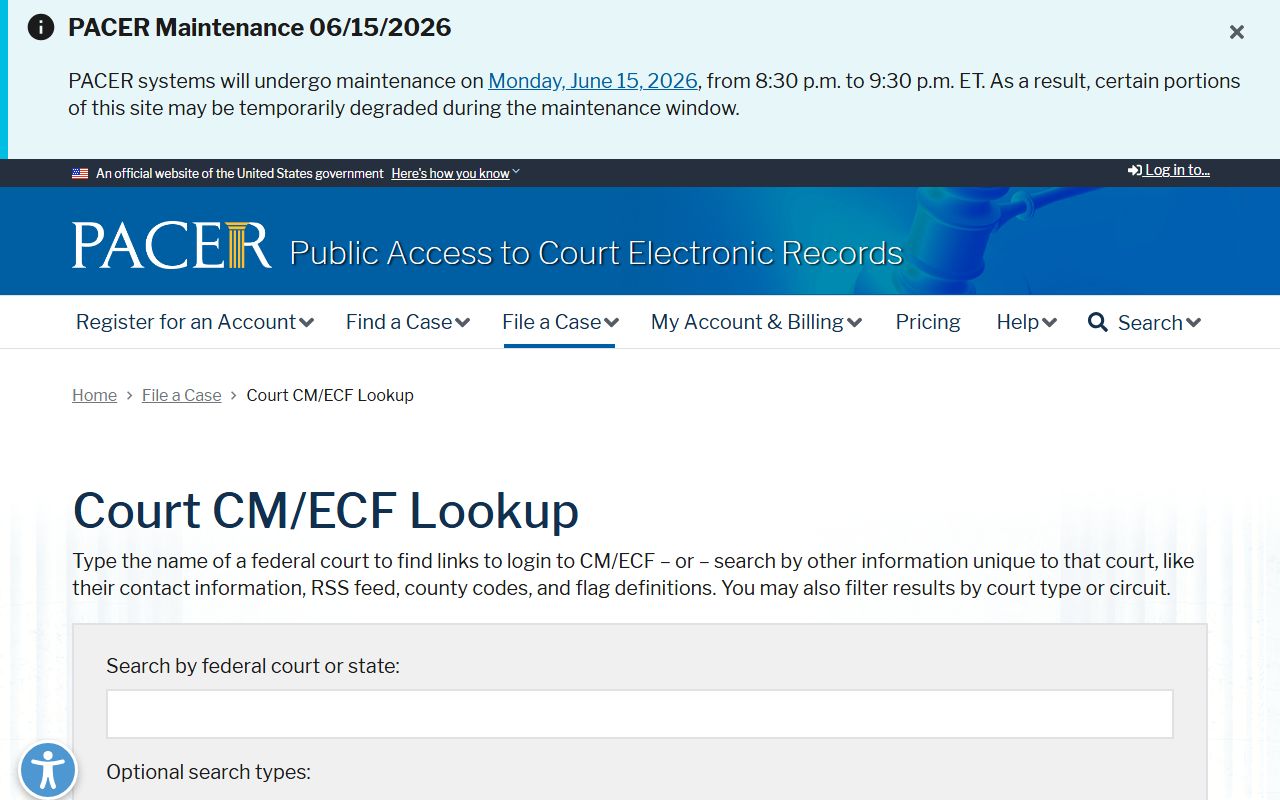
That directory routes a search to the right district when a case did not originate in eastern Oklahoma. PACER access usually requires a registered account, and viewing documents can carry per-page charges.
Federal Charges in the Eastern District
Carter County falls inside the U.S. District Court for the Eastern District of Oklahoma, a district of 26 counties. Federal charges cover crimes against federal law, and those cases stay out of the Carter County state portals. The court's main site is the first stop for filings, rules, and contacts. The Eastern District of Oklahoma homepage links the clerk's office, judges, and electronic access.
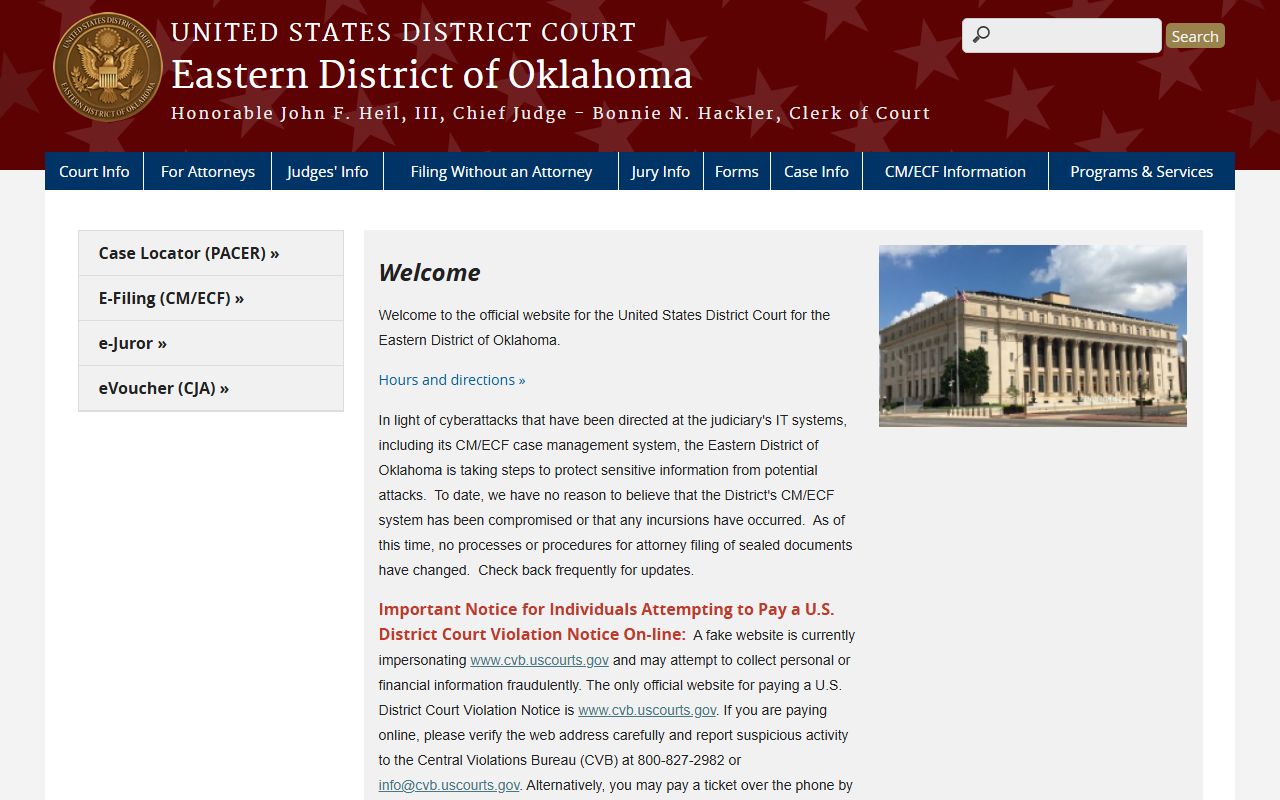
The homepage explains how the district is organized and which offices hold which records. Electronic filing and docket viewing run through a separate login. The Eastern District CM/ECF login is the gateway for attorneys and registered users.
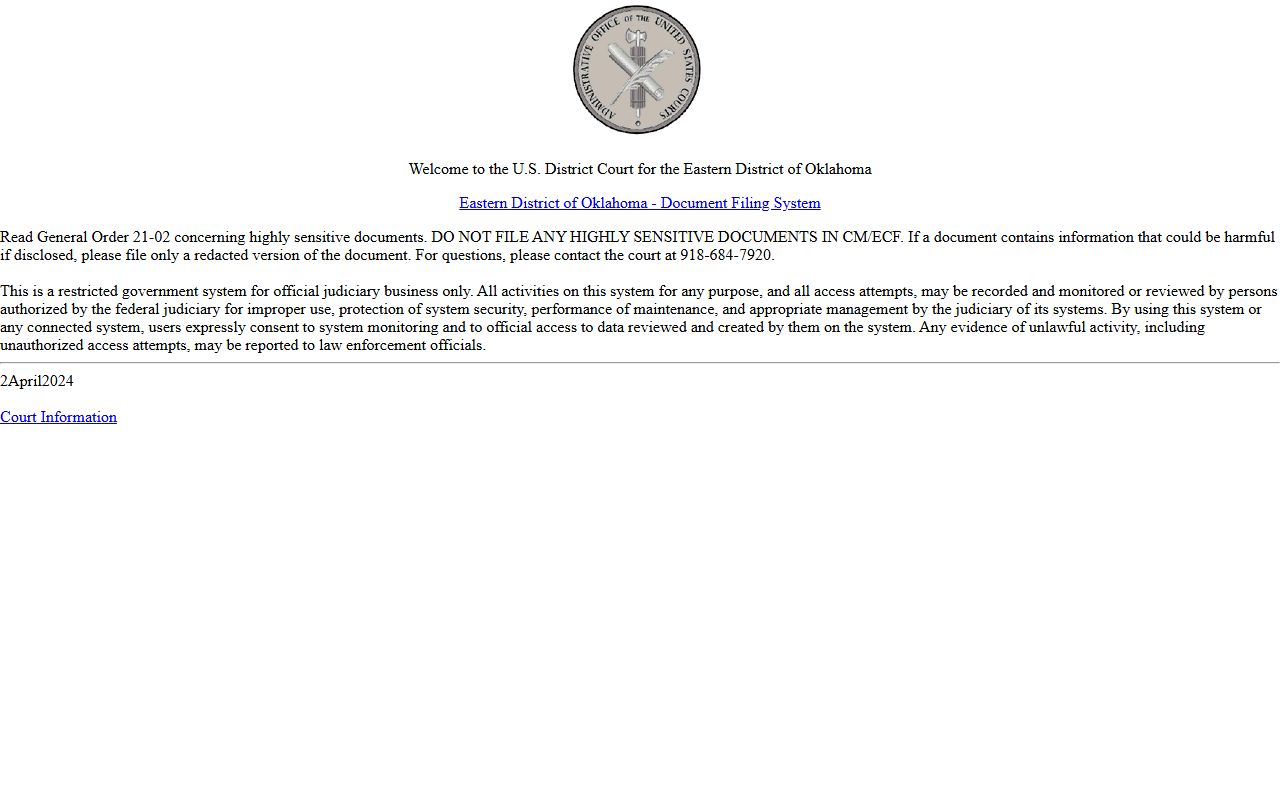
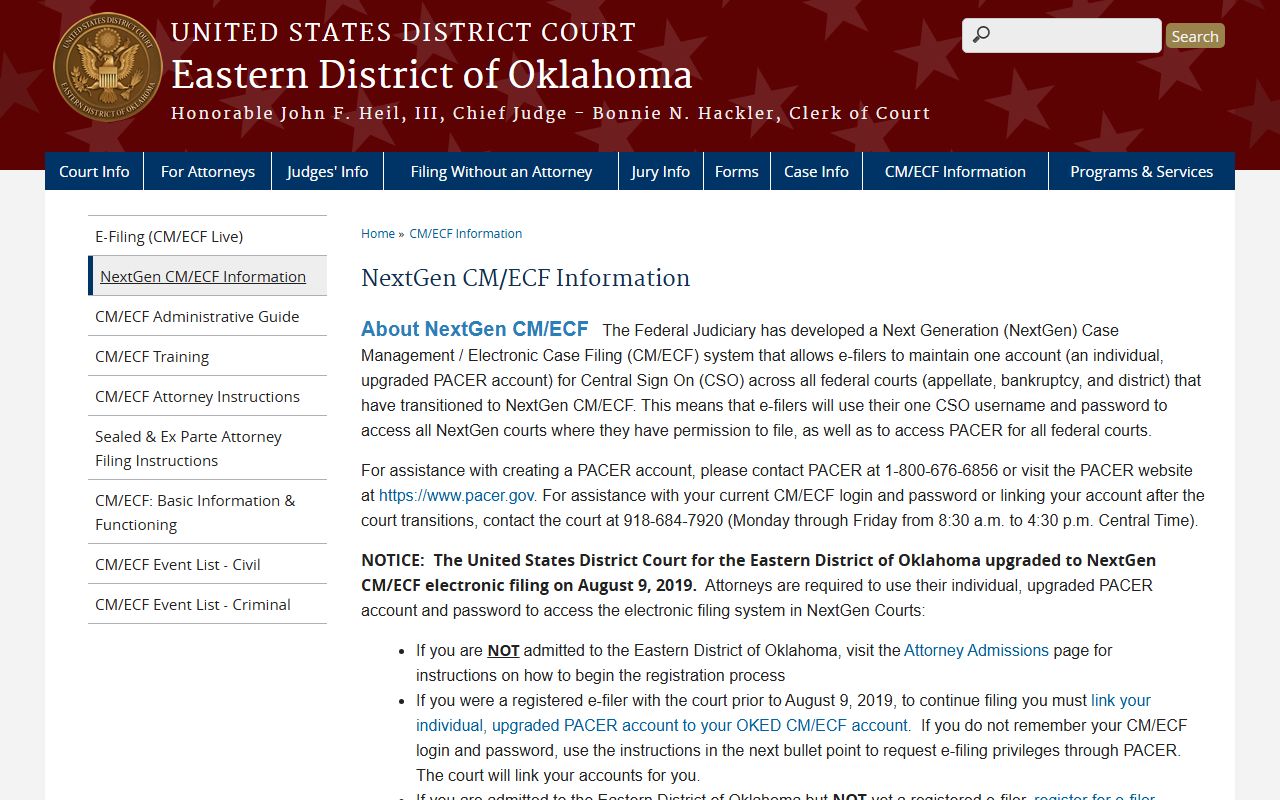
CM/ECF is mandatory for electronic filing in the district. The system moved to a newer platform several years ago, and the court keeps a guide for it. The NextGen CM/ECF information page walks users through linked accounts and access steps.
Note: Federal charges and state charges are wholly separate, so a Carter County resident can have a federal case with no matching record in any Oklahoma district court portal.
Carter County Sealed and Expunged Records
Some Carter County charge records leave public view through sealing or expungement. The two are not the same. Oklahoma sets eligibility under 22 O.S. 18, and OSBI says it cannot pre-approve a request before a court signs an order. Once a Carter County court grants relief, the public search portals may stop showing the case or may show only restricted information.
| Sealed | Expunged | |
|---|---|---|
| Visibility | Hidden from public | Treated as if it never existed |
| Law Enforcement | Limited access | Very limited access |
| Eligibility | Set by 22 O.S. 18 | Set by 22 O.S. 18 |
Carter County Background Check Limits
A casual Carter County docket search is not a formal background check. People run quick lookups to read a charge or check a status. A regulated background check for hiring, housing, or credit must follow the Fair Credit Reporting Act and pull from a screening provider. The two serve different goals. A filed charge alone is not a conviction, and treating an open or dismissed charge as proof of guilt can be both wrong and unlawful.
Important: This site is not a consumer reporting agency under the FCRA, and its records may not be used for hiring, housing, credit, or other FCRA-regulated decisions.
Restricted Carter County Charge Records
Not every Carter County charge record is open. Oklahoma law keeps several categories out of public search results, and the Open Records Act does not override records made confidential by other law. The state framework at 51 O.S. 24A.5 opens public records for inspection, but it yields where another statute applies. Several charge-related records fall under that limit.
- Juvenile charges, which are confidential under 10A O.S. 1-6-102.
- Sealed and expunged cases removed by court order.
- Some dismissed charges that get withheld or restricted.
- Open investigations before a charge is filed.
Court records can also redact personal identifiers such as Social Security numbers, financial account numbers, and the names of minors. Online dockets often show a summary rather than the full clerk file. When a record does not appear or shows only limited detail, the Carter County Court Clerk at the courthouse is the office to confirm whether the case is restricted, sealed, or simply not yet digitized.