
Active Warrants in Carter County
A warrant is a court order. It lets police arrest a person, search a place, or bring someone before a judge. In Carter County, the Court Clerk issues legal warrants and court orders once a judge signs them. The Carter County Sheriff's Office then serves and enforces those warrants. No public website lets anyone pull a full Carter County warrant list by name. That gap shapes every warrant search in Carter County.
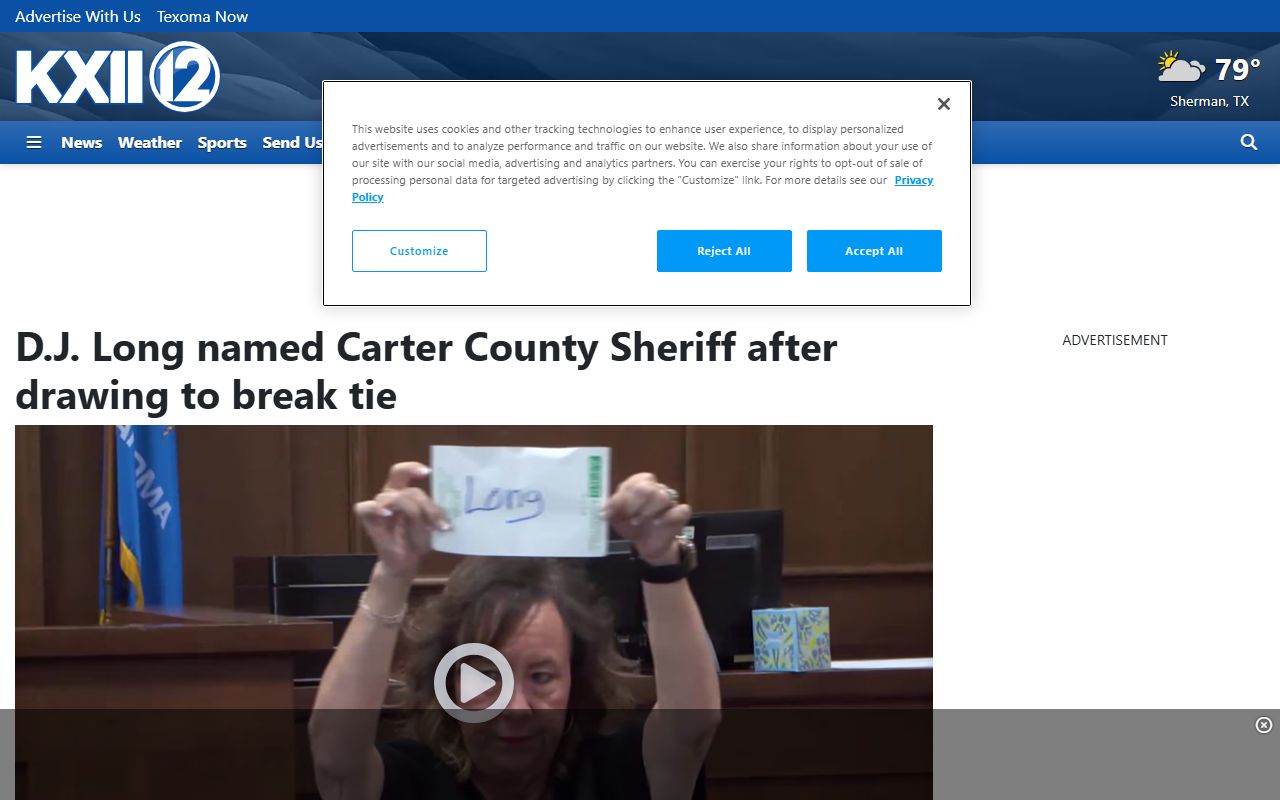
The office that serves warrants is run by an elected sheriff. The Carter County Sheriff's Office posted that D.J. Long was sworn into office at the Carter County Courthouse in early 2025.
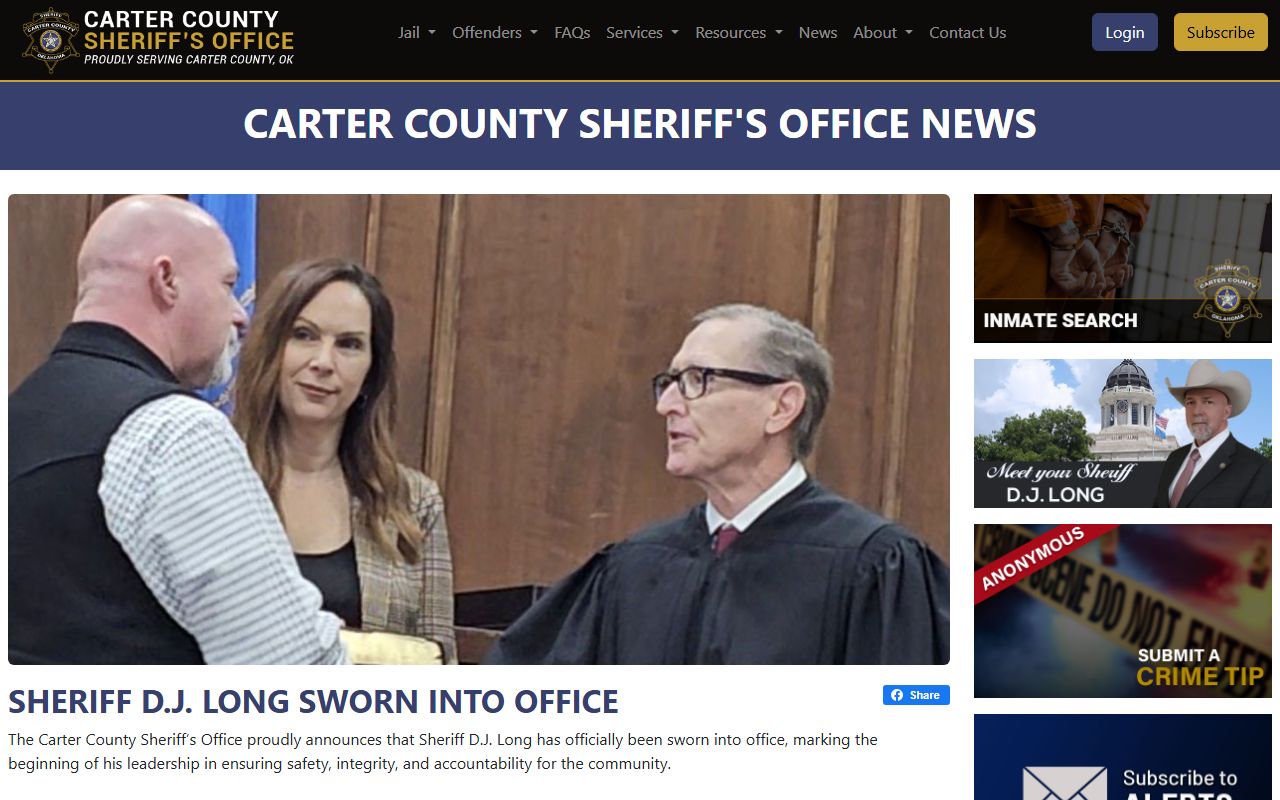
Long leads the agency that fields warrant questions, books arrests, and posts most-wanted information. Deputies handle warrant inquiries by phone during business hours. Active warrants stay open until the person is arrested, surrenders, or a judge recalls the order.
How to Check for a Carter County Warrant
Several channels can confirm an active Carter County warrant. None is a one-click name search. The right path depends on whether the warrant came from a state district case or a city court. Court-issued warrants connect to a live case file. Most-wanted listings cover only a small set of named fugitives.
- Review the Sheriff's most-wanted page for any listed Carter County fugitives.
- Call the Carter County Sheriff's Office at (580) 223-6014 for warrant and tip information.
- Search OSCN or ODCR for open criminal cases and warrant docket entries.
- Contact the Court Clerk at (580) 223-5253 for a court-issued warrant tied to a case.
- Check Ardmore Municipal Court for city bench, traffic, or ordinance warrants.
- File a records request with the Sheriff's Office when the record is not online.
Each channel holds a different slice of the picture. The Sheriff knows who is wanted now. The Court Clerk knows which case produced the order. A city court holds its own bench warrants, which do not appear in the state district system.
The Carter County Most-Wanted List
The Carter County Sheriff publishes a most-wanted page. It is the closest thing Carter County offers to an online warrant list. The page names selected fugitives and asks the public to call or send a tip. It is not a full warrant roster, and it does not let you search your own name.
The Sheriff's most-wanted and warrant list shows photos and basic details for a short set of wanted people.
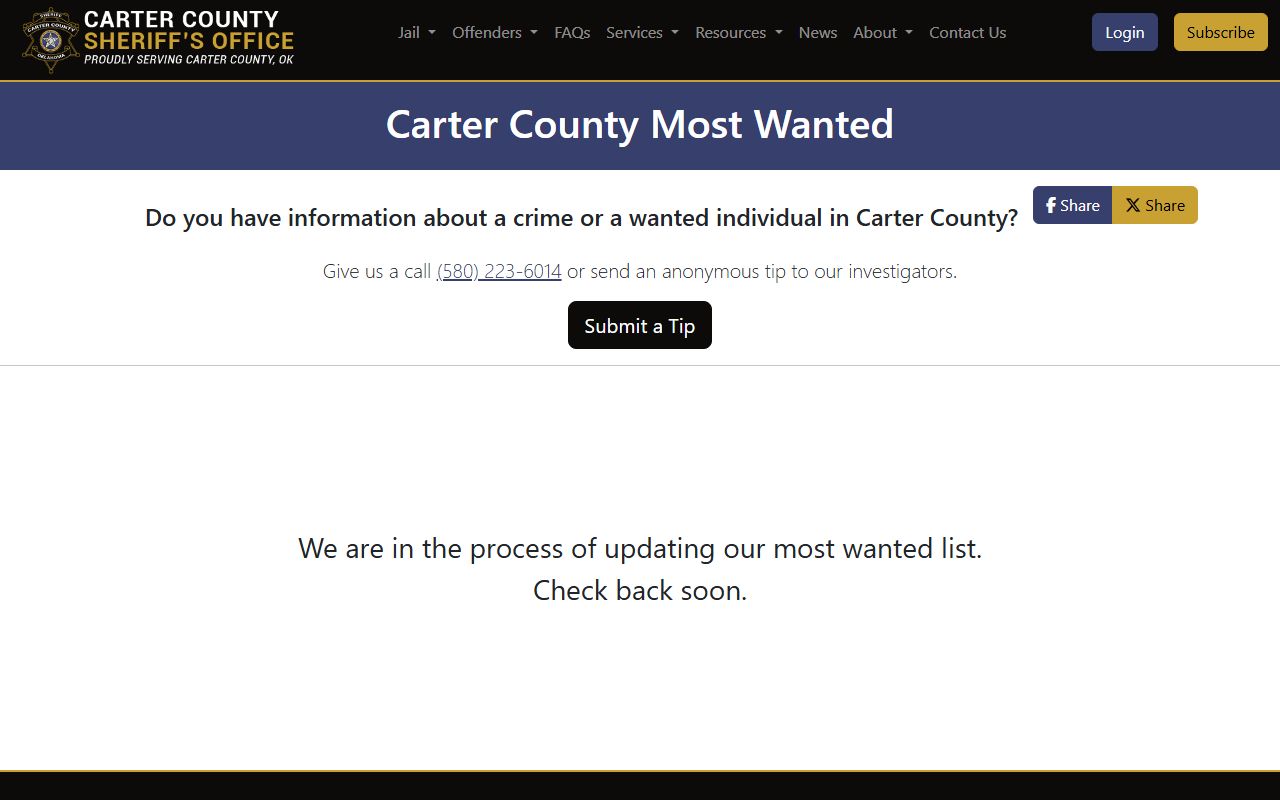
The page carries a firm disclaimer. Listed names may not be current, since accounts can be cleared fast and the list updates only on a routine basis. Bond and case amounts are approximate and may shift with fees, payments, and penalties. The Sheriff warns the public not to act on the listing alone and not to attempt any apprehension.
Important: The most-wanted listing is not represented as current for any legal purpose, so always confirm an active warrant with the Sheriff or the Court Clerk before relying on it.
Contacting the Sheriff and Anonymous Tips
The Sheriff's main line is the front door for warrant questions. Carter County asks the public to call (580) 223-6014 for nonemergency warrant and tip information. People who would rather stay nameless can use the Carter County anonymous tip form. The form accepts tips about wanted fugitives, outstanding warrants, missing persons, and unsolved cases.
The county's anonymous tip form keeps the report simple and lets the sender stay private.
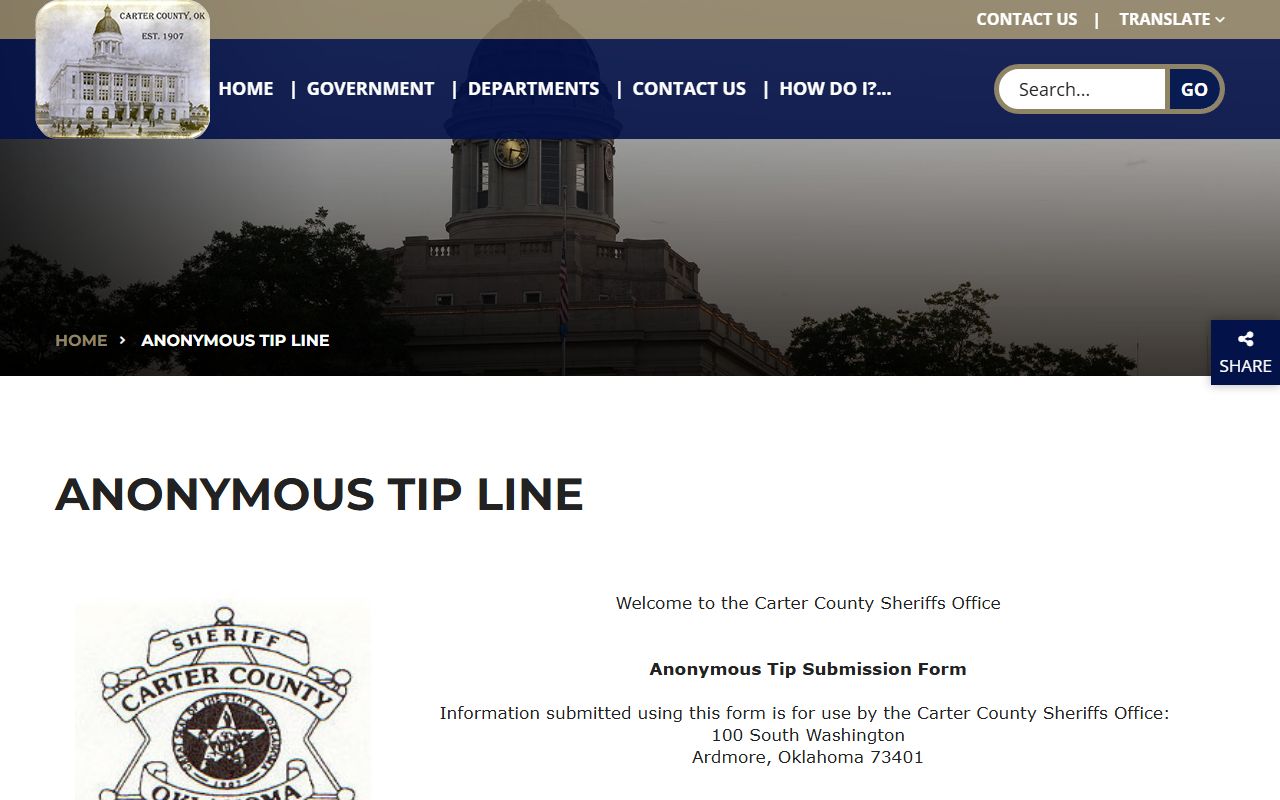
Only the subject and message fields are required. Name, phone, and email are optional, so a tipster can leave them blank. The fields below show how the form is set up.
| Field Label | Type | Required | Notes |
|---|---|---|---|
| Subject | Text | Yes | Short topic of the tip, such as an outstanding warrant. |
| Message | Text area | Yes | Details about the wanted person, case, or location. |
| Name | Text | No | Optional, so the tip can stay anonymous. |
| Phone | Text | No | Optional contact number for follow-up. |
| Text | No | Optional contact email for follow-up. |
Types of Warrants in Carter County
Carter County warrants fall into a few common groups. Each starts in a different way and serves a different purpose. A judge backs every one of them. Knowing the type helps you find the right office to ask.
- Arrest warrant - issued when police show probable cause that a person committed a crime, allowing officers to take that person into custody.
- Bench warrant - issued by a judge, often after a person fails to appear for a scheduled court date.
- Search warrant - signed by a judge to let officers search a named place or item, and filed in the district system under the SW case code.
- Capias - a warrant-like order that directs officers to bring a person before the court, sometimes for unpaid fines or fees.
Bench warrants drive much of the Carter County open-warrant load. A missed hearing or an unpaid traffic fine can trigger one. The order stays active until the person appears or clears the case.
What a Carter County Warrant Listing Shows
The Sheriff's most-wanted entries follow a set template. Each listing gathers a handful of fields meant to help the public identify a wanted person. The list does not show full warrant text, case numbers, or court costs. It centers on description and the reason the person is wanted.
| Field | What It Shows |
|---|---|
| Wanted For | The reason the person is sought, such as a charge or open warrant. |
| Bond Amount | An approximate bond figure that may change with fees and payments. |
| Aliases | Other names the person is known to use. |
| Last Known Location | The most recent place tied to the person. |
| Sex | The listed sex of the wanted person. |
| Race | The listed race of the wanted person. |
| Hair Color | A physical description field. |
| Eye Color | A physical description field. |
These fields support identification, not legal action. Bond amounts in particular are flagged as approximate. For an exact charge, bond, or case number, the Court Clerk's file is the official source.
Court-Issued Warrants in Carter County
Most warrants in Carter County begin as a court order. The Carter County Court Clerk issues legal warrants and court orders for the District Court. Those warrants attach to a live case, so they show up as docket activity rather than a standalone search tool. The two statewide systems let you trace that activity.
OSCN and ODCR both carry a search warrant case type and list warrant docket entries inside open criminal cases. A party-name or case-number search can surface a warrant return, a bench-warrant note, or a related order. The Sheriff also enforces civil court orders, and the office posts sheriff sales tied to writs and foreclosure judgments.
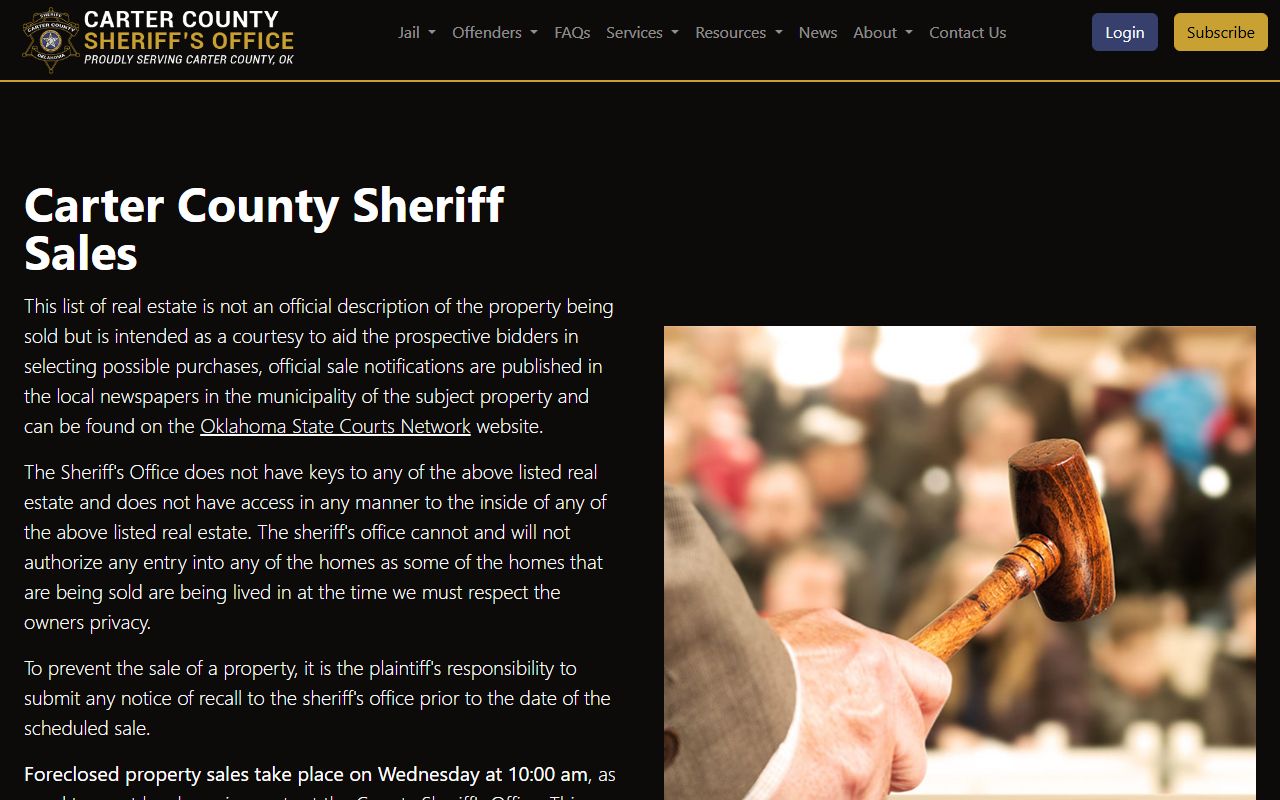
Sheriff sales show how a court order moves from paper to enforcement. The same office that serves an arrest warrant also carries out civil writs. For the full case behind a warrant, the charges, pleas, and outcome live in the Carter County criminal court records.
Municipal Bench Warrants in Ardmore
Not every Carter County warrant sits in the district system. City cases run through municipal courts. Ardmore Municipal Court processes city ordinance violations, misdemeanor arrests, citizen complaints, and traffic citations. A missed city court date can produce a municipal bench warrant that the district search will not show.
The split matters for traffic and minor cases. OSCN can search district traffic citations by citation number, but it states plainly that it does not search municipal citations. A driver who got a city ticket in Ardmore may need the Ardmore Municipal Court rather than the county or state portals. Other towns in the county, such as Lone Grove, run their own municipal courts as well.
Note: If you cannot find a warrant in the district court records, ask whether the citation or arrest was filed by a city police department rather than the county.
The Carter County Warrant-Clearing Event
Open warrants are a large and visible problem in Carter County. In 2026, Carter County held a warrant-clearing event to help residents resolve open cases. Court Clerk Renee Bryant said her office organized the program. The effort drew wide local attention because of the sheer number of warrants on the books.
A March 2026 KXII report covered the warrant-clearing event and gave a detailed count of outstanding warrants.
The county reported 4,253 outstanding warrants at the time. The breakdown showed how many fall into each group:
- 1,678 misdemeanor warrants
- 1,668 felony warrants
- 907 traffic warrants
The program gave people a path to face an open case instead of risking a surprise arrest. Events like this can change the count fast, which is one reason the most-wanted list and any unofficial total can fall out of date quickly.
Outstanding Warrants and What to Do
An outstanding warrant does not go away on its own. It can lead to an arrest at a traffic stop, at work, or at home. Handling it on your own terms is almost always better than waiting. A clear plan starts with knowing what the Carter County warrant is for.
- Confirm the warrant by calling the Sheriff's Office or checking the case in OSCN or ODCR.
- Speak with a defense attorney before you take any action.
- Ask whether a bond can be posted or a new court date set.
- Plan a voluntary surrender so the matter is resolved on schedule.
A voluntary appearance often looks better to a judge than an arrest. Once a person is booked, custody and charge detail show up in the Carter County inmate records.
Important: Talk with a licensed attorney before you turn yourself in, since a lawyer can arrange bond, plan the surrender, and protect your rights at every step.
Restricted Carter County Warrant Records
Not all Carter County warrant records are open to the public. Some never appear online for legal reasons. A search warrant can be sealed while an investigation is active. Juvenile matters are confidential under Oklahoma law, so juvenile warrants stay out of public search. Federal warrants are handled by federal courts and do not show in the county or state systems.
When a record is not online, the Sheriff's records request process is the next step. The Sheriff's Office, now led by D.J. Long, who won the 2024 sheriff race, charges a small fee for incident reports.
A report request runs about five dollars, and some records must be picked up in person. For court-issued warrants, the Court Clerk remains the official keeper of the file. Sealed and expunged cases may stop showing in OSCN or ODCR once a judge signs the order.