
Carter County District Court Overview
Oklahoma runs its trial courts as district courts, and the Carter County District Court is the court of general jurisdiction for the county. General jurisdiction means the court can hear nearly any kind of case. Felony and misdemeanor crimes start here. So do civil suits, family and divorce matters, probate, guardianship, protective orders, traffic citations, juvenile cases, small claims, and search warrant requests. The court opens a file under a case code, tracks each hearing on a docket, and closes the case with a judgment or order. Most public court records in the county trace back to this one court.
The court is based in Ardmore, the county seat. Its judges, staff, and the Court Clerk share the Carter County Courthouse downtown. The District Court is not the only court that touches county residents. City courts handle local ordinance cases, and federal courts handle federal matters. Yet for state crimes and most civil disputes, the District Court is where the case lives. Free online tools let the public follow these cases from filing to close.
Carter County and the 20th Judicial District
Oklahoma groups its counties into judicial districts. Carter County sits in the 20th Judicial District. Four neighbors share the district with it. Those counties are Johnston, Love, Marshall, and Murray. The district judges and the District Attorney serve all five counties, not just one. This shared structure is why a Carter County judge or prosecutor may also work cases in nearby counties.
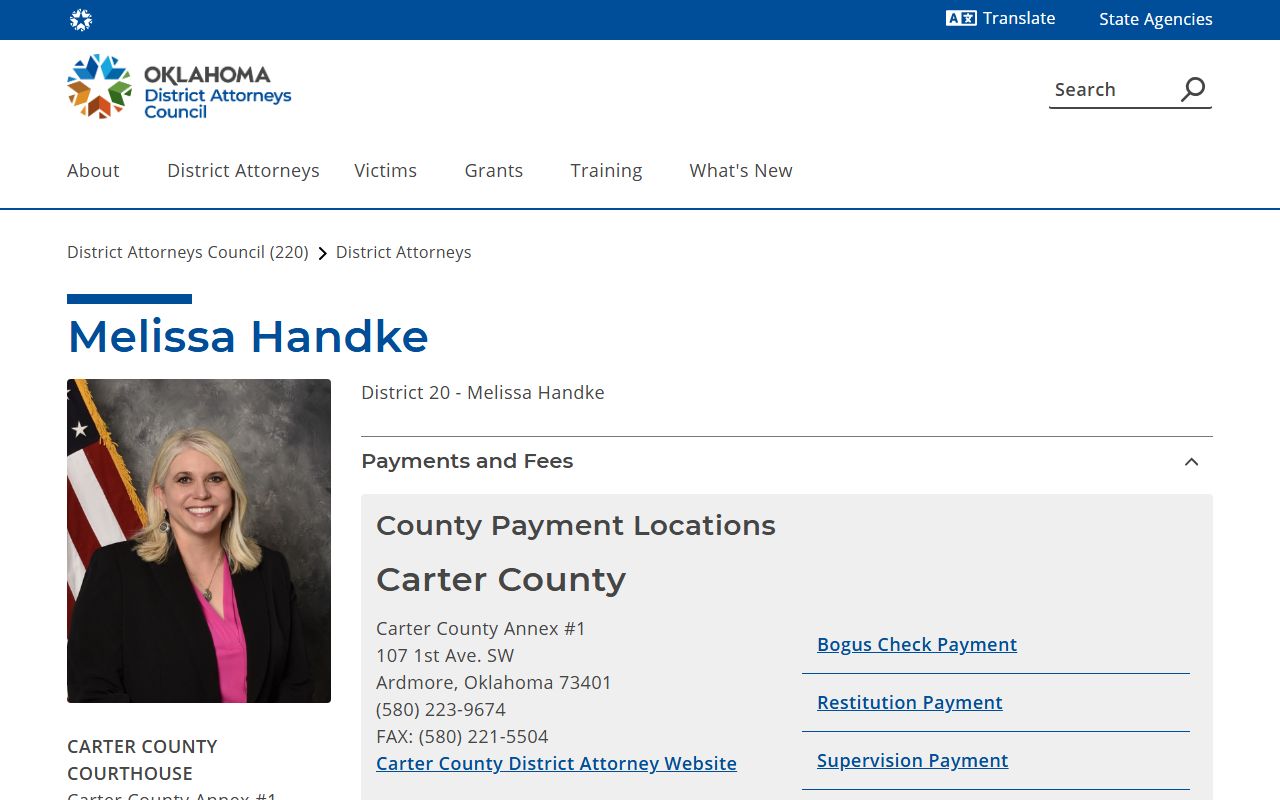
The District Attorney for District 20 is Melissa Handke. Her prosecutors bring state criminal charges across the district. The state's District Attorneys Council District 20 page lists the county offices, payment links, and the full county roster. The same page confirms that Carter County anchors the district. Handke is the first female District Attorney for the 20th District.
The district map matters for record searches too. A case may move between counties when a judge or prosecutor handles it, but the file still opens in the county where the matter was filed. For Carter County matters, that home court is the District Court in Ardmore.
Judges of the Carter County District Court
Carter County has three local judges. Each holds a rank set by Oklahoma's court system. Carson Brooks serves as the District Judge, the senior trial judge. Ryan Hunnicutt serves as the Associate District Judge. Johnny Loard serves as the Special District Judge. Together they carry the full case load of the district court, from felony trials to small claims hearings.
| Judge | Role | Courthouse Location | Phone |
|---|---|---|---|
| Carson Brooks | District Judge | 20 B Street SW, Suite 304, Ardmore | (580) 223-3803 |
| Ryan Hunnicutt | Associate District Judge | 20 B Street SW, Ardmore | (580) 223-3803 |
| Johnny Loard | Special District Judge | 20 B Street SW, Suite 201, Ardmore | (580) 223-3803 |
The District Judge and the Special District Judge keep offices on different floors of the courthouse. The 2026 Oklahoma Judicial Directory confirms the courthouse suites and the shared office phone line. The Associate and Special judge roles exist because of a past reform in Oklahoma's courts. That history explains the three different ranks seen in the county today.
Note: Judges decide cases and sign orders, but they do not hold the case files; record requests and certified copies go to the Court Clerk instead.
Case Types in the Carter County District Court
Every case in the Carter County District Court opens under a case code. The code marks the kind of case. It pairs with the filing year and a sequence number to form the full case number. A search on the state portals uses these codes to sort and find results. The most common district court codes show up again and again in public dockets.
- CF marks a Criminal Felony case.
- CM marks a Criminal Misdemeanor case.
- CV marks a general civil case.
- FD marks a Family and Domestic case, such as a divorce.
- PB marks a Probate case.
- PO marks a Protective Order case.
- TR marks a Traffic case.
Other codes appear too. CJ marks civil jurisdiction matters, SC marks small claims, SW marks search warrants, WL marks wildlife cases, and YO marks youthful offender cases. A case number like CF-2026-1 reads as a felony filed in 2026. Once you know the code, the rest of the search is quick.
Criminal cases open only after the District Attorney files charges, and the Carter County District Attorney office handles that work for the whole district. 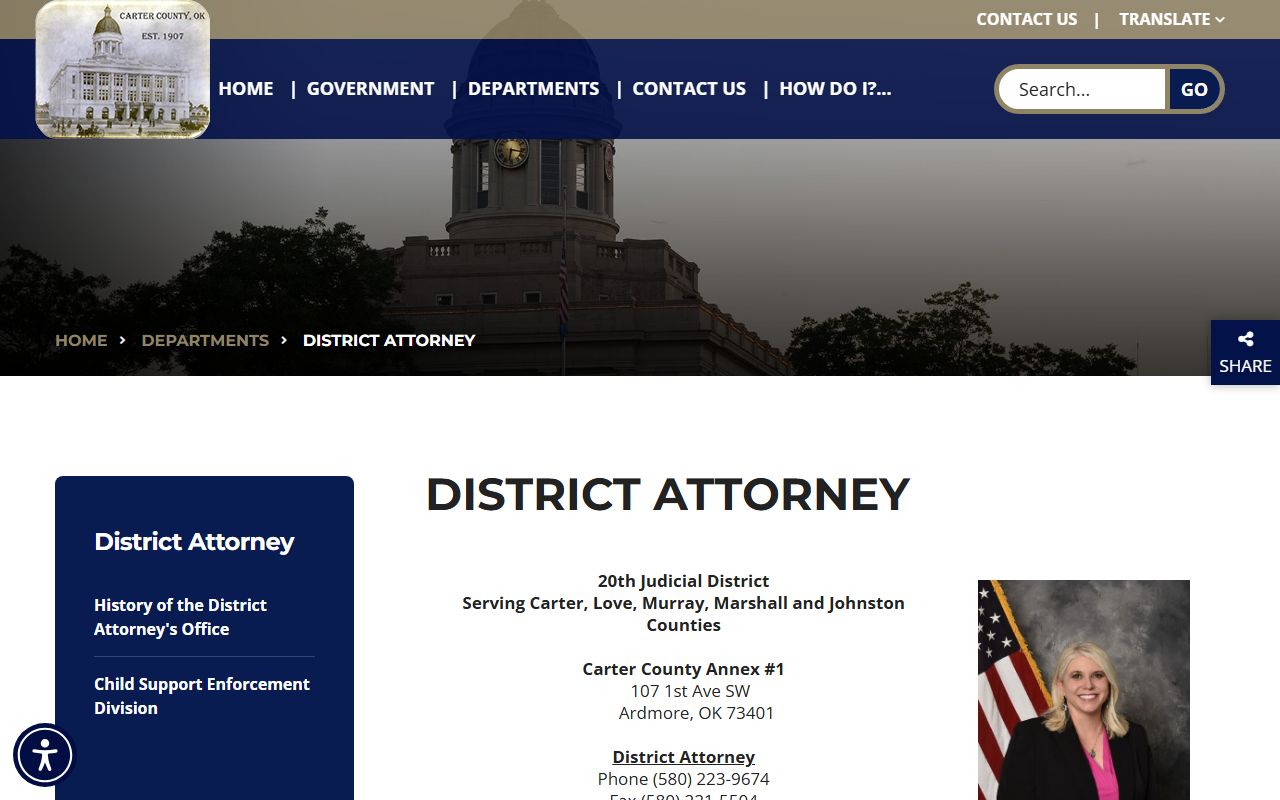 The DA office sits at the Carter County Annex #1 on 1st Avenue SW. An arrest does not by itself create a court case. The court file begins when the prosecutor charges the matter and the clerk opens a docket.
Role of the Carter County Court Clerk
The Carter County Court Clerk keeps the records the District Court creates. Renee Bryant leads that office. Her staff records, files, and maintains every District Court proceeding. They keep the appearance docket, hold the case files, collect fines and fees, and distribute court money to dozens of agencies. The Court Clerk also issues legal warrants, court orders, and marriage licenses. Her direct line is (580) 223-5253.
Because the clerk holds the official file, the online dockets are only a copy. The state portals warn that online data is not the official record. To get a certified copy or to see an older file that is not fully digitized, contact the clerk's counter. The role of the Carter County Court Clerk is the key access point for any document the District Court has signed.
Court funding ties back to the clerk too. The office collects fines, fees, and bond forfeitures, then sends those funds to more than 35 agencies as the law requires. That is one reason a single court case can show many separate cost line items.
District Court vs. Municipal Court
The District Court is not the only court in the county. Cities run their own municipal courts under city code. A municipal court handles city ordinance violations and city traffic tickets, not state felonies or civil suits. Ardmore and Lone Grove both run municipal courts. This split matters for any search, because the two court levels keep separate records.
| District Court | Municipal Court | |
|---|---|---|
| Authority | State trial court of general jurisdiction | City court created under municipal code |
| Cases Heard | Felony, misdemeanor, civil, family, probate, protective order, traffic, juvenile, small claims | City ordinance violations, city traffic citations, some state-law misdemeanor arrests, citizen complaints |
| Where Filed | Carter County Courthouse, Ardmore | Ardmore or Lone Grove city court |
| Online Search | OSCN and ODCR | Not searchable on OSCN; municipal citations are excluded |
The Ardmore Municipal Court page states that the city office processes ordinance violations, state-law misdemeanor arrests, citizen complaints, and traffic citations. 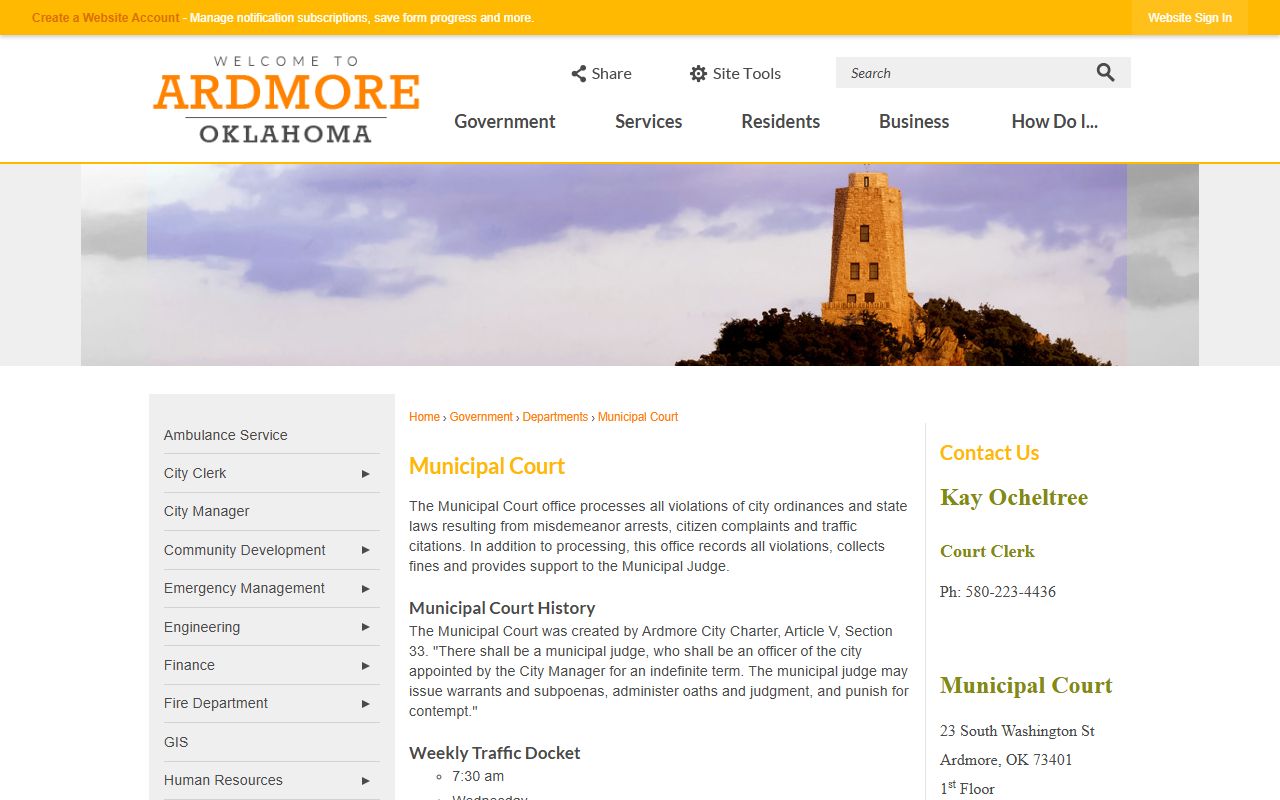 The state docket system says plainly that its citation search does not cover municipal citations. So a city speeding ticket may never appear in a District Court search. When a citation is missing online, ask which court the case was filed in before driving downtown.
How a Carter County Case Moves Through the System
A case follows a set path once it opens. The path differs for criminal and civil matters, but both run through the District Court first. The court hears the case, rules on it, and enters a final order. Only then can a party ask a higher court to review the result. The flow below shows the common steps.
Criminal flow: Arrest › Initial Appearance › Charges Filed by Information › Arraignment › Preliminary Hearing › Pretrial › Plea or Trial › Sentencing › Appeal to the Oklahoma Court of Criminal Appeals
Civil flow: Petition Filed › Answer › Discovery › Pretrial › Trial › Judgment › Appeal to the Oklahoma Supreme Court
Oklahoma splits its final appeals between two top courts. Civil appeals route to the Oklahoma Supreme Court, which may assign a case to the Court of Civil Appeals for a first review. Criminal appeals route to the Oklahoma Court of Criminal Appeals instead. The District Court record stays the base file for any appeal. You can follow that base file and its docket entries through the county court dockets while a case is still active.
Some cases never touch state appeals because they belong to the federal system. Carter County falls in the U.S. District Court for the Eastern District of Oklahoma, which handles federal crimes and federal civil suits. 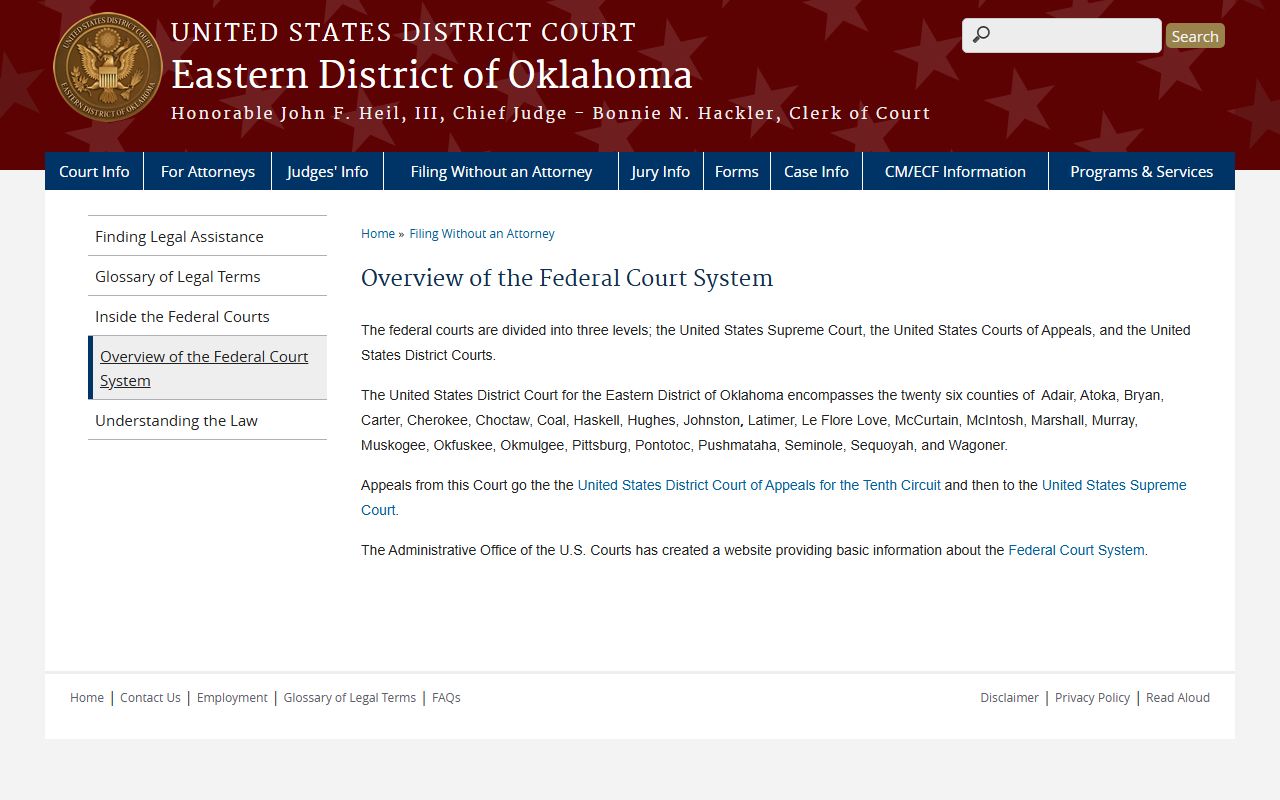 The court's federal court overview lists Carter among the 26 counties it serves. Appeals from that federal court go to the U.S. Court of Appeals for the Tenth Circuit, not to the state courts.
Local Court Rules in Carter County
The Carter County District Court sets local rules for conduct in its courtrooms. The rules treat attorneys as officers of the court. They must be courteous and civil. They must use proper courtroom decorum at all times. The rules also set a dress standard for anyone who appears before a judge.
The county's local court rules page spells out the attire standard. Men must wear a dress coat and tie. Women must wear a business dress, dress trousers and a coat, or a business skirt and blouse. Attorneys are also expected to advise clients on proper courtroom behavior. Anyone with a hearing should plan to dress and act for a formal setting.
Note: The county does not publish parking rates, security screening times, or locker rules online, so confirm entry details with the Court Clerk or District Court before you appear.
Visiting the Carter County Courthouse
The District Court and the Court Clerk share the Carter County Courthouse in downtown Ardmore. The judicial offices sit on the third floor. The County Administration Building and the District Attorney's Annex are a short drive away, so check which office holds your record before you go. The contact block below covers the main District Court office.
Carter County District Court
#20 "B" Street SW, 3rd Floor, Room 304
Ardmore, OK 73401
(580) 223-3803
Hours: call the office to confirm current business hours.
Ardmore is easy to reach from several main roads. Drivers come in from Interstate 35 through the Ardmore exits into the downtown grid. Others arrive on US-70 toward Lone Grove or Madill, or on US-77 along South Commerce Street. The courthouse, clerk, and nearby county offices all cluster in the same downtown area. Plan for a formal court setting once you arrive.
History of the Carter County District Court
Carter County was created at Oklahoma statehood in 1907. Ardmore became the county seat and remains the home of the court. The county takes its name from Ben W. Carter, a Cherokee man who lived among the Chickasaw. The District Court has served the county from its earliest days as the main trial court.
The court's structure changed with statewide reform. After Oklahoma created the office of District Attorney, Burke Mordy became the first person elected to it in the 20th Judicial District. The judiciary later abolished the old County Courts and the Justice of the Peace Courts. In their place it created the Associate District Judge and Special Judge offices. James Dillard and Earl Brown were the first to hold those new posts in Carter County.
This history still shapes the court today. Oklahoma no longer uses Justice of the Peace courts, so city cases route to municipal courts instead. The District Judge, Associate District Judge, and Special District Judge ranks all trace back to that reform. For most county records, the path still leads to the District Court and its Carter County court records.